Private Road Construction in East Texas
Getting onto your property — reliably, in all weather, year after year — isn’t something you want to leave to chance. A road or driveway that wasn’t built correctly from the ground up will show it within a season or two: rutting under load, puddling after rain, washing out where the slope wasn’t thought through, and slowly deteriorating until it becomes a maintenance problem that costs more to fix than it would have cost to build right the first time.
Ward’s Tractor Service builds private roads and driveways across East Texas that are engineered for the land they’re built on and the conditions they have to handle. We’ve been doing this work for nearly a decade throughout Walker County, Montgomery County, and the wider East Texas region — and we know what road construction in this part of Texas actually requires.
What Private Road Construction Actually Involves
Private road and driveway construction is a multi-phase process, and each phase matters. Skipping steps or cutting corners at any point in the sequence creates problems that compound over time. Here’s how we approach it:
Site Assessment and Route Planning
Before any equipment moves, we walk the property and assess the proposed road alignment. This involves evaluating the terrain — identifying slopes, low areas, drainage paths, existing vegetation, and any soil conditions that could affect construction or long-term performance.
Route planning isn’t just about the most direct line from A to B. It’s about finding an alignment that works with the natural drainage of the land, avoids problematic soil areas where possible, minimizes the amount of cut and fill required, and positions the finished road so that water drains off it rather than pooling or running down it.
Clearing and Right-of-Way Preparation
Once the route is established, the right-of-way needs to be cleared. In East Texas, that often means removing trees, brush, and stumps from a corridor wide enough to accommodate the finished road with appropriate clearance on both sides.
We use our dozer, skid steer, and mulching equipment to clear the right-of-way efficiently — taking out everything that needs to go while leaving adjacent vegetation intact where appropriate. Stumps are removed or ground down below grade so they don’t become obstacles or create voids under the road surface as they decompose.
Subgrade Preparation and Earthmoving
The subgrade is the foundation of the road — the shaped, compacted layer of native soil that everything above it sits on. Getting this right is arguably the most important step in the entire process.
We use our dozers and trackhoe to establish the roadbed at the correct elevation and cross-slope. This involves cutting down high areas, filling low spots, and shaping the surface with a slight crown — typically higher in the center than on the edges — so that water sheds off the road rather than pooling on it. In areas where the subgrade soil is particularly soft or problematic, additional preparation steps are taken before base material goes down.
The finished subgrade is compacted to provide a stable, settled base that won’t shift or settle unevenly under load or after rain.
Drainage Design and Installation
Drainage is the detail that separates a road that lasts from one that fails. Water is the primary cause of road deterioration — whether it’s surface water that pools and softens the base, water running along the road and eroding the edges, or subsurface moisture undermining the structure from below.
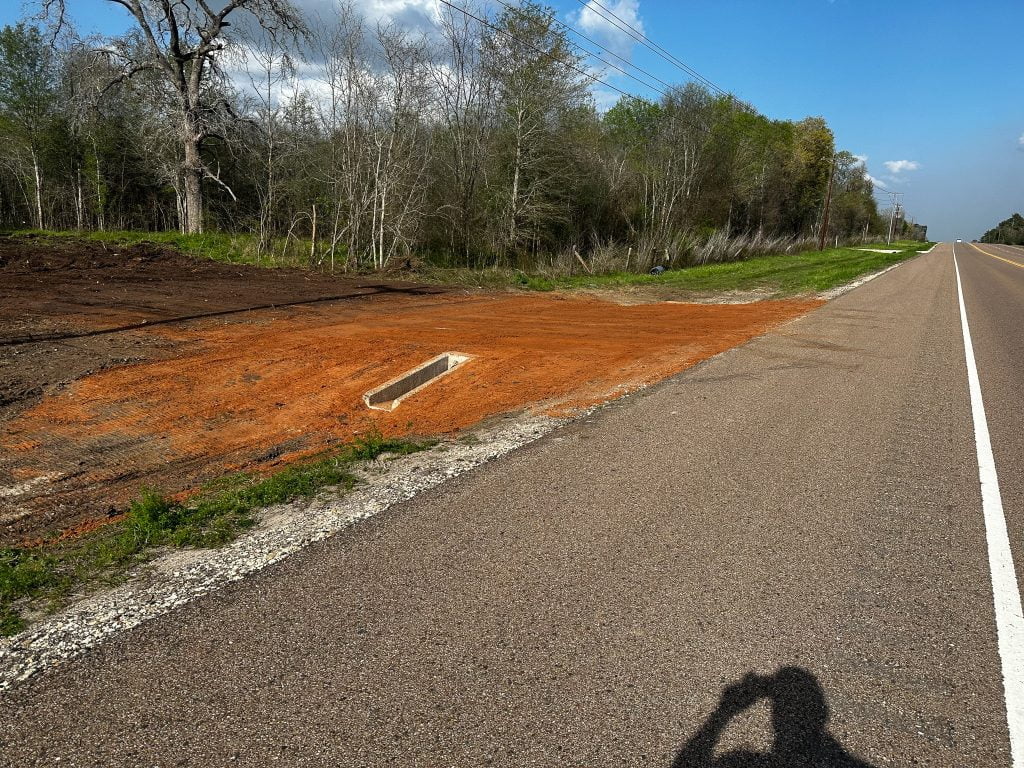
We address drainage through a combination of properly designed crown grade, roadside ditches or swales that channel water away from the road surface, and culverts at cross-drainage points where water naturally flows across the road alignment. Every culvert is sized and positioned to handle the volume of water that realistically flows through that location during heavy rain — not undersized pipes that back up and fail the first time a significant storm rolls through.
East Texas rainfall patterns make this particularly important. We build drainage into every road project from the design phase forward, not as an afterthought.
Base Material and Surface Application
With the subgrade prepared and drainage addressed, base material goes down. For most private roads and driveways in East Texas, this means crushed limestone or caliche — stable, compactable aggregate that binds together and provides a firm, durable driving surface.
The base is spread and graded to maintain the proper crown and drainage slope established in the subgrade, then compacted. Depth of base material varies based on the road’s intended use, the volume of traffic it will carry, and the underlying soil conditions — a ranch road that sees heavy equipment traffic regularly is built to a different spec than a residential driveway.
Additional gravel surface material can be applied over the base for improved drainage and surface durability.
Types of Road and Driveway Projects We Build
Residential Driveways
New driveways, extended driveways, and driveway repairs and improvements. We build residential driveways that handle East Texas weather without developing ruts, puddles, or washouts — starting with proper base prep and ending with a gravel or compacted surface that holds up year over year.
Private Ranch and Farm Roads
Internal roads on large agricultural and ranch properties take a beating from equipment, livestock, and weather. We build ranch roads to handle that load — wider roadbeds, deeper base, and drainage designed for the volume of surface water that moves across large acreage during rain events. Long private roads through wooded East Texas terrain require careful route planning to work with the land rather than against it.
Rural Development Access Roads
Rural subdivisions, hunting camps, recreational properties, and multi-structure rural developments all need access infrastructure. We build the road systems that make these properties functional — from a single entry road to a network of interior access lanes serving multiple structures or use areas.
Driveway and Road Repair
Existing roads and driveways that have developed problems — ruts, potholes, drainage failures, washed-out sections — can often be regraded, supplemented with base material, and returned to proper condition without full reconstruction. We assess what’s needed and provide the right solution, whether that’s a regrading pass, additional material, drainage corrections, or full rebuild of a failed section.
Why East Texas Road Construction Is Different
Road construction anywhere requires knowledge of local conditions — but East Texas presents a specific set of variables that make local experience genuinely matter.
The rainfall here is substantial and can be intense. Roads that aren’t built with serious drainage consideration don’t survive East Texas wet seasons intact. The soil conditions across our service area vary significantly — sandy, well-draining soils in some areas, dense clay that holds moisture and swells in others, and transitional zones between the two. A road built without accounting for the soil it sits on will settle, shift, and fail in ways that more careful construction would prevent.
The vegetation is dense and fast-growing, which affects both the clearing phase and the long-term maintenance of road edges and drainage structures. And the terrain — from flat bottomland to rolling pine country — affects route design and drainage planning differently on every property.
We’ve built roads across these conditions for nearly a decade. That experience is built into how we plan, design, and execute every road project.

Why Choose Ward's Tractor Service for Road Construction
- A Complete Equipment Fleet for Every Phase Road construction requires multiple types of equipment across its phases — dozer work for subgrade preparation, trackhoe for drainage and culvert installation, skid steer for finish work and material spreading, and compaction equipment for base preparation. We have the full fleet to handle every phase without subcontracting.
- Nearly a Decade of East Texas Road-Building Experience We’ve built private roads and driveways across Walker County, Montgomery County, San Jacinto County, Trinity County, and the wider East Texas region. The local terrain knowledge we bring to road planning and drainage design comes from years of doing this work in this specific environment.
- Drainage-First Approach We build drainage into every road project from day one. It’s not an add-on or an afterthought — it’s the design consideration that determines how we set the grade, where we place culverts, and how we shape the roadside swales. Roads built this way hold up. Roads built without it don’t.
- Family-Owned and Locally Based Ward’s Tractor Service is a Huntsville-based family business. Cody Ward leads the operation personally, and the quality standard he holds applies to every job — including your road project.
- Honest Estimates, Clear Communication We assess the property, walk the proposed route, and put together a clear estimate before any equipment starts. You’ll know what the project involves, what it costs, and when it will be done before we begin.
Ready to Build Your Road? Let's Talk.
Contact Ward’s Tractor Service today for a free on-site consultation and estimate on private road or driveway construction. We’ll walk the property, assess the route, and put together a plan that gives you a road built to last.
To learn more about our road construction services or to request a consultation, contact us today. Let Wards Tractor Service show you why we’re the trusted name in road construction across East Texas. With our expertise, your roadway will be a testament to quality, durability, and professionalism.